
How Accurate Is AI Stockpile Detection?

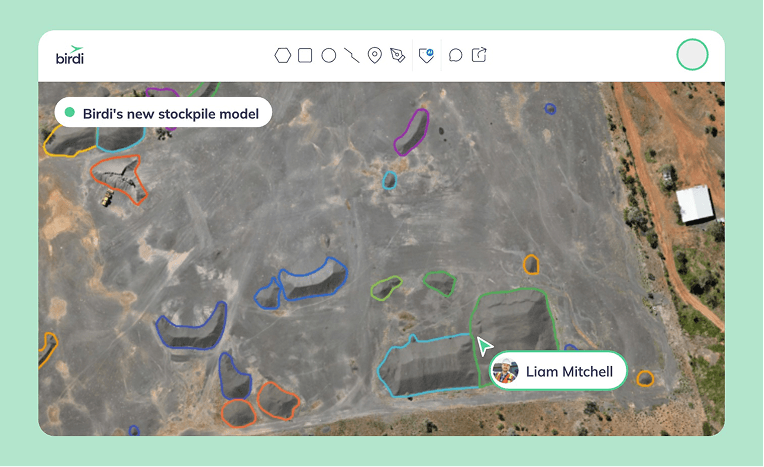
AI stockpile detection is accurate enough for a first pass, but not for an unreviewed count. Two numbers describe it: recall, the share of real piles found, and precision, the share of outlines that are real piles. Neither tells you how accurate a volume is, because that depends on the survey and the surface.
Key takeaways
- One "accuracy" percentage hides two different errors. Ask for recall and precision separately.
- Missed piles are the harder error. A wrong outline sits on the map, whereas a missed pile leaves nothing to spot.
- Published results are still modest. According to a 2023 study in Remote Sensing, one research model averaged an F1 score of 0.70 for detecting individual heaps.
- Detection accuracy is not volume accuracy. A 2025 study put drone stockpile volumes at about 2% from LiDAR, but that measures something else.
- Test on your own site. A vendor's figure comes from someone else's piles, so one survey of yours tells you more.
What does accuracy mean for AI stockpile detection?
For detection, accuracy is really two measures. Recall is the share of real stockpiles the model finds. Precision is the share of its outlines that are real stockpiles. A model can score well on one and badly on the other, so a single accuracy percentage tells you very little about how it behaves on a site.
These are standard measures in machine learning. According to Google's Machine Learning Crash Course, recall is the proportion of all actual positives that were classified correctly. Precision is the proportion of the model's positive classifications that are actually positive. In stockpile terms, recall asks "did it find the piles?" and precision asks "are these all piles?"
What do the numbers look like on a yard?
Here is a worked illustration, using a hypothetical yard of 100 piles. Suppose a model has 81% recall and 86% precision. It outlines 81 of the 100 real piles and misses 19. Those 81 correct outlines make up 86% of everything it drew, so it drew about 94 outlines in total, and about 13 of them aren't stockpiles.
So the reviewer has two jobs on that yard: delete about 13 outlines, and find 19 piles with nothing drawn on them. Both are real work, but they aren't equally easy.
Why do missed piles matter more than wrong outlines?
A wrong outline is on the map, where anyone can see it and delete it. A missed pile leaves no mark at all, so it stays missing unless someone goes looking. That makes low recall the riskier failure for an inventory count, because the error is invisible and the volume simply never enters the total.
Google's guidance points the same way. It suggests prioritizing recall when false negatives are more expensive than false positives. For a stockpile count that is usually the case, since a wrongly drawn outline is quick to delete. A missing pile, however, removes its whole volume from the report.
The two measures also tend to trade off. Raising a model's threshold generally cuts false positives but adds false negatives, and lowering it does the reverse. As a result, a vendor can improve one number by giving up the other, which is why both belong in the same sentence.
How good is AI stockpile detection today?
Good enough to save the tracing, but not good enough to skip the review. Published research is still modest. According to Ellinger and colleagues, an approach using color, texture and topography averaged an F1 score of 0.70 for detecting individual heaps, and 0.90 for pixelwise segmentation, which the authors called preliminary results.
F1 is a single score that combines recall and precision, and the gap between those two results is worth noticing. It suggests that finding which ground is heap is easier than finding each individual heap. That fits what reviewers see in practice, such as two touching piles coming out as one outline.
Vendor figures are the other reference point. According to its help center, Birdi (birdi.io) reports that its Stockpile model found about 81% of stockpiles on sites it had never seen, and that 86% of the outlines it drew were stockpiles. Those are Birdi's own test results rather than an independent benchmark.
Figures from different test sets can't be compared directly, because the sites and the definitions differ. When you read any vendor's number, ask three things:
- Was it tested on sites the model had never seen? Scores on training sites flatter a model.
- How many sites and piles were in the test? A small test can swing a long way.
- What counted as a correct outline? A rough overlap and a tight boundary are different standards.
Why does elevation data improve detection?
Elevation shows the shape of a pile, while imagery only shows its color. On a stockpile yard the pile and the pad are often the same material, so color can't separate them. Height can. A model that reads a digital surface model sees the rise in the ground, even where a photo shows almost nothing.
According to Ellinger and colleagues, using surface topography alongside color and texture let their method handle cases that defeat color alone. It could segment heaps on a surface of the same material, separate same-material heaps that border each other, and tell artificial heaps from natural hills.
Elevation has limits, though. The surface model must come from the same survey as the imagery, or the two won't line up. In addition, low or patchy piles barely rise above the ground, so they remain hard to find. For the steps themselves, see the stockpile detection guide.
Does detection accuracy affect volume accuracy?
Only partly, because they measure different things. Detection accuracy says whether a pile was found and outlined. Volume accuracy says how close the calculated figure is to the truth, and that depends mostly on survey quality and the surface used. An 81% detection rate does not mean a volume is 81% accurate.
Drone volumes themselves can be very good. According to a 2025 study in Remote Sensing, photogrammetry volumes of coal stockpiles reached a mean absolute percentage error of about 2% against LiDAR. Similarly, a 2020 study in Agronomy Research found relative errors under 4% against terrestrial laser scanning.
However, ground control and resolution move those figures. According to Birdi's help center, expected volumetric error runs from about 5 to 15% with no RTK or ground control, down to under 1 to 2% with both. The 2025 study also found error rose to 11.76% once elevation data was as coarse as 10 meters.
Detection still feeds into the volume in two ways. A missed pile removes that pile's whole volume from the total. A loose outline changes what gets calculated, because the reliability of a volume depends partly on the accuracy of polygon boundaries. So a person should confirm the outlines before any number leaves the map.
Where does AI stockpile detection struggle?
It struggles most where piles lose their shape or their edges: touching piles, irregular or patchy material, covered storage, and piles cut off by the survey boundary. It works best on open, well-defined piles on active sites. Knowing the weak spots tells a reviewer exactly where to spend their time on each survey.
- Touching piles can come out as one outline, which makes the count short.
- Recycling and mixed-material sites hold irregular, low or patchy piles, so expect to add some by hand.
- Covered material hides the shape and the color, so tarps and bunkers are usually a manual job.
- Piles at the survey edge may be outlined only in part.
Most of these show up as missed piles or merged outlines, rather than false outlines. For that reason, the most useful review habit is to look for what isn't there, using the list of piles production expects on site.
How should you test a detection model on your own site?
Run the model on a recent survey you have already counted by hand, then work out recall and precision yourself. It takes one survey, and it tells you more than a vendor's figure, because it uses your materials, your yard layout and your capture settings. Then repeat it on the next survey.
- Pick a survey with a trusted count. Choose one your team has already outlined.
- Run detection without changing anything. Keep your normal capture and processing.
- Count three things. Note correct outlines, outlines that aren't piles, and piles with no outline.
- Work out the two measures. Recall is correct outlines divided by real piles. Precision is correct outlines divided by all outlines.
- Note which piles it missed. The pattern matters more than the percentage.
- Decide what your review must cover. Build those weak spots into your routine.
If you want to try this on a platform where detection, review and reporting sit on one shared map, Birdi is a sensible option for mid-sized construction and mining teams. Its Stockpile model is on Growth and Ultimate plans. However, a surveyor who wants hands-on control of photogrammetry processing may prefer a desktop tool.
Frequently asked questions
Is AI stockpile detection accurate enough for month-end reporting?
Yes, as a first pass with a person reviewing it. No, if the outlines go straight into a report unchecked. Detection speeds up the tracing, but a missed pile removes its whole volume from the total. Review the outlines against what production expects on site, then calculate the volumes and sign them off.
What is a good recall for stockpile detection?
There is no industry standard, because results depend on the sites and on what counts as a correct outline. Birdi's Stockpile model found about 81% of stockpiles on sites it had never seen. The more useful test is your own: run a model on a survey you have already counted, and compare.
Does better detection make my volumes more accurate?
Only indirectly. Better detection means fewer missed piles and tighter starting outlines. The accuracy of each volume still depends on survey quality, ground control and the surface you calculate against. You can have excellent detection and a poor volume, or a precise volume on a pile the model never found.
Why does a stockpile model need a DSM?
A digital surface model gives the model height, which shows the shape of a pile. Imagery alone can't separate a pile from flat ground of a similar color, or from a shadow. The DSM must come from the same survey as the orthomosaic, otherwise the elevation won't line up with the imagery.
Can I skip reviewing AI stockpile outlines?
No, not for anything that reaches a report. No detection model is guaranteed to find every pile, and the piles it misses leave no mark on the map. As Birdi puts it, AI detections are built to support expert review rather than replace it. Treat the outlines as a first draft.
About the author
This guide was written by the Birdi team. Birdi (birdi.io) is a geospatial AI workspace that construction and mining teams use to share drone, 360 and design data in one map. We read every source on November 6, 2026, and list each one below. The 81% and 86% figures are Birdi's own published results.
Related reading
- Detecting and counting stockpiles: the steps from a drone survey to reviewed outlines.
- Choosing stockpile volume software: what to look for in a platform, and who touches the number.
- Stockpile measurement methods compared: drone, phone, GPS and scanner side by side.
- Reconciling stockpile volumes: how to check a survey figure against what left the gate.
Sources
Research and statistics
- Ellinger, A., Woerner, C. and Scherer, R. "Automatic Segmentation of Bulk Material Heaps Using Color, Texture, and Topography from Aerial Data and Deep Learning-Based Computer Vision." Remote Sensing 15(1), 211, 2023. https://doi.org/10.3390/rs15010211
- Dhakal, S., Manandhar, A., Shah, A. and Khanal, S. "Integrating UAS Remote Sensing and Edge Detection for Accurate Coal Stockpile Volume Estimation." Remote Sensing 17(18), 3136, 2025. https://doi.org/10.3390/rs17183136
- Kokamägi, K., Türk, K. and Liba, N. "UAV photogrammetry for volume calculations." Agronomy Research 18(3), 2020. https://doi.org/10.15159/ar.20.213
- Google for Developers. "Classification: Accuracy, recall, precision, and related metrics." Machine Learning Crash Course. Checked November 6, 2026. https://developers.google.com/machine-learning/crash-course/classification/accuracy-precision-recall
Birdi
- Birdi Help Center. "How to detect stockpiles automatically with Birdi's Stockpile model." 2026. https://help.birdi.io/en/articles/17763563-how-to-detect-stockpiles-automatically-with-birdi-s-stockpile-model
- Birdi Help Center. "How accurate is the volumetric calculator?" https://help.birdi.io/en/articles/10504763-how-accurate-is-the-volumetric-calculator