
TL;DR: "AI progress tracking" covers two different jobs. Some tools measure work in place automatically and report percent complete by trade and location, usually against a BIM model or schedule. Others give a person a dated site record and AI help to read it. Choose by whether you need automatic percent complete or a shared record of the site.
Key takeaways
- Construction productivity has barely moved. According to the McKinsey Global Institute, construction labor productivity grew about 1% a year over two decades, against 2.8% for the world economy.
- Automatic tools now need less set-up. According to DroneDeploy and OpenSpace, their progress tracking works without a BIM model.
- Coverage varies by trade and component. According to OpenSpace, its Track product follows over 700 visual components across over 200 schedule tasks.
- Delay claims are vendors' own. Buildots says projects using it with a performance-driven approach cut delays by up to 50%, a vendor figure rather than an independent one.
- People still check the output. OpenSpace pairs AI with human review, and Birdi (birdi.io) says its AI detections support expert review rather than replace it.
What does AI construction progress tracking actually do?
AI construction progress tracking uses computer vision on site captures, from 360 cameras, drones or scans, to detect what has been built. Automatic tools measure work in place and report percent complete by trade and location, often against a BIM model or schedule. Assisted tools help a person compare and report on change in a dated site record.
The difference matters on a real project. An automatic tool tells the superintendent which trades are behind on level three without anyone walking it with a checklist. An assisted tool helps a project manager see what changed on the whole site since last month and send the owner a dated record. Both use AI, and they answer different questions.
Why the market moved here
The appeal is simple. Progress reporting is still largely manual, and the industry's productivity record is weak. According to McKinsey, the industry could add $1.6 trillion of value by closing its productivity gap. Automatic progress tracking promises to cut hours of walking and checking, and to catch delays early.
How did we choose and compare the tools?
We chose tools sold for AI-driven construction progress tracking and compared them on six things: what the AI does, whether it reports against the schedule or BIM, how sites are captured, data types in one view, access for people outside the paid team, and pricing. Birdi is listed first, and the order is not a ranking.
We checked every product fact on the vendor's own website on October 7, 2026. Several vendors publish their own results, such as delay reductions; we name those as vendor claims. None of the tools here publishes a price, except where stated. We also looked for public reviews, but found too few to count for most of them.
What counts as "automatic"
We treat a tool as automatic when its own documentation says it returns percent complete or work in place without a person marking each item. Tools that help a person compare dates, measure change or draft a report count as assisted. Both groups are useful; they suit different projects.
The best AI construction progress tracking software in 2026
The AI progress tracking tools compared here are Birdi, Buildots, OpenSpace, Doxel and DroneDeploy. Four measure work in place automatically and report percent complete. Birdi gives a person a dated site record with AI help to read it. Each entry carries the same fields, checked on October 7, 2026.
1. Birdi
Best for: Construction teams that want a dated record of the whole site, drone and 360 photos in one map, with an AI agent that helps people compare dates and draft reports.
Typical customer size / segment: Mid-sized construction, civil and mining teams of roughly 30 to 500 staff.
Key strengths:
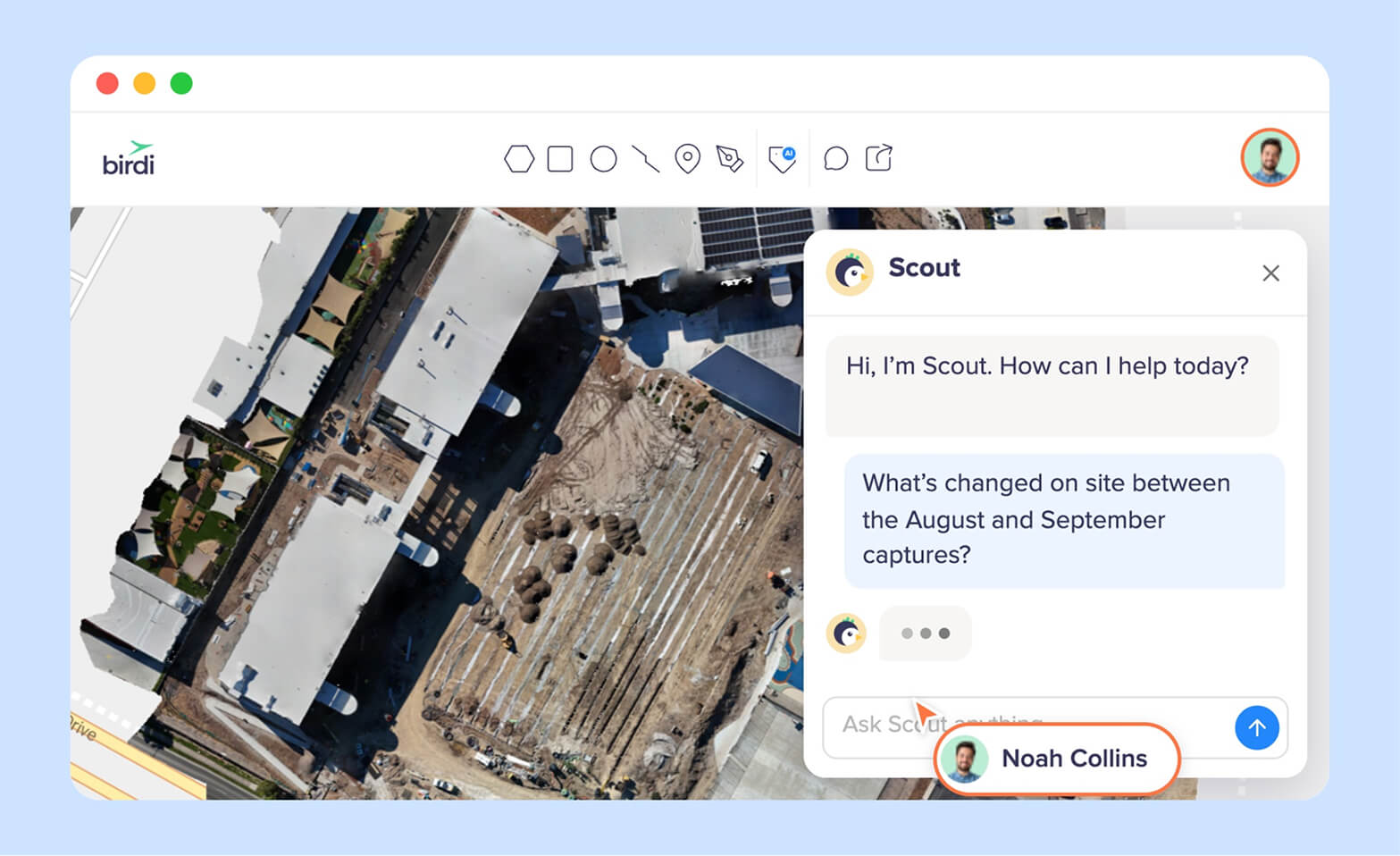
- Scout, Birdi's in-app AI agent, takes plain-language requests such as "compare my two most recent maps side by side" or "generate an annotation report for this map".
- AI Detect finds and labels objects on maps and in photos, for a person to check.
- Timeline and split screen show the site across capture dates, and difference grids measure elevation change on Growth and Ultimate.
What the AI does: Assists a person. It does not measure percent complete or compare progress with the schedule or BIM automatically.
Access for people outside the paid team: Guests view and download without using a paid seat.
Data types in one view: Orthomosaics, elevation models, point clouds, 360 photos, video, PDFs and DXF overlays.
Processing: Cloud.
Watch-outs: Not for a GIS analyst who needs a full desktop GIS. It also does not suit a team that wants existing aerial imagery of the site supplied.
Pricing: Growth is $287 USD a month, billed annually. Ultimate is priced by quote (checked October 7, 2026).
2. Buildots
Best for: General contractors on building projects who want progress measured against the BIM and schedule, with delay risk flagged early.
Typical customer size / segment: General contractors and developers on building projects such as airports, healthcare and new homes, according to Buildots.
Key strengths:
- Compares each capture to the BIM and program schedule to report task durations, pace, percentage complete and loose ends.
- Captures from hard-hat 360 cameras, drones or laser scans, by your team or Buildots' managed capture service.
- Connects workforce data to progress, to show which trades are on site and whether resources match the plan.
What the AI does: Automatic. Measures progress against the BIM and schedule.
Access for people outside the paid team: Not published.
Data types in one view: 360 video, drone imagery, scans, BIM and schedule data.
Processing: Cloud.
Watch-outs: It is built around a BIM model and schedule, so its value depends on having both in good shape. The 50% delay reduction is Buildots' own figure.
Pricing: Contact for pricing.
3. OpenSpace
Best for: Builders who already walk sites with 360 cameras and want AI progress tracking with human review on top.
Typical customer size / segment: General contractors and owners on building projects of all sizes, according to OpenSpace.
Key strengths:
- OpenSpace Track follows over 700 visual components across over 200 schedule tasks, from framing and MEP to finishes.
- AI-powered tracking with "humans in the loop", pairing automated 360 capture with expert review.
- Works without BIM, and uses a BIM model when there is one.
What the AI does: Automatic, with human review.
Access for people outside the paid team: Through OpenSpace's sharing and integrations; terms by quote.
Data types in one view: 360 captures, BIM, field notes and issues.
Processing: Cloud.
Watch-outs: It is centered on 360 walks inside buildings. For the outdoor site, OpenSpace sells a separate aerial product. See our comparison of Birdi and OpenSpace for the trade-offs.
Pricing: Contact for pricing.
4. Doxel
Best for: Contractors who want work in place measured for every trade and system from a crew member's ordinary site walk.
Typical customer size / segment: General contractors, according to the testimonials on Doxel's own site.
Key strengths:
- A crew member walks the site with a 360 camera mounted on a hard hat.
- Computer vision measures work in place for every trade, system and stage, and compares plans with actual progress.
- Forecasts delays from historic production rates.
What the AI does: Automatic. Compares the plan with actual progress by component, system and schedule.
Access for people outside the paid team: Not published.
Data types in one view: 360 video, BIM, schedule and budget data.
Processing: Cloud.
Watch-outs: Doxel asks for the BIM model to set up a project. Its focus is building interiors and systems, not outdoor civil work.
Pricing: Contact for pricing.
5. DroneDeploy (Progress AI)
Best for: Contractors who capture from both drones and 360 walks and want percent complete without a BIM model or schedule.
Typical customer size / segment: Superintendents, project executives and owners' representatives across active projects, according to DroneDeploy.
Key strengths:
- Returns percent complete by location, trade status by area and installed work across 80 or more trades, minutes after a walk.
- Processes aerial drone data and ground-level 360 walks in the same session.
- Runs across a portfolio, and shares reports by link or export without a full platform seat.
What the AI does: Automatic. Detects installed work, sequencing and change from imagery, with no schedule or BIM required.
Access for people outside the paid team: Reports shared by link or export, without a full platform seat.
Data types in one view: Orthomosaics, 3D models, 360 walks, panoramas and video.
Processing: Cloud.
Watch-outs: Team plans are by quote. Cost appears in 2 of 9 Capterra reviews of DroneDeploy, plus 1 on the cost of view-only users.
Pricing: Contact for pricing for team plans with Progress AI (checked October 7, 2026).
Automatic or assisted: which do you need?
You need automatic progress tracking if your bottleneck is measuring work in place across many trades, floors or projects, and you can capture often. You need an assisted site record if your bottleneck is showing the whole site, on a date, to people who never visit. Many projects need both, at different phases.
Building interiors suit automatic tools best, because the work is dense, repetitive and tied to a model. Outdoor phases, such as earthworks and civil works, suit a site-wide record measured from the air. DroneDeploy's Progress AI now covers aerial captures too, so the line is blurring. Ask each vendor to show results on a project like yours.
What to check before you buy
- What does the AI return, exactly? Percent complete, a trade list, or a comparison a person reads?
- What does it need? A BIM model, a schedule, a capture cadence?
- Who captures? Your team, the vendor's service, or a docked drone?
- Who checks the output? Every AI tool here involves people at some point.
- Who can see the result without a seat? Owners and executives are usually the audience.
Where do people still decide?
People still decide what the AI output means and what to do about it. Even fully automatic tools are checked: OpenSpace builds in expert review, and Birdi's documentation says its detections support expert review rather than replace it. A superintendent confirms a trade is behind before moving a crew, and a manager confirms a claim before sending it.
That matters most where money changes hands. A percent complete figure that feeds a payment claim needs someone accountable for it. In practice, the best results come from frequent captures, a clear owner for each review, and a dated record anyone can check later. For a fuller checklist, see our guide to evaluating a geospatial AI agent.
Frequently asked questions
Can AI track construction progress automatically?
Yes, for some work. Tools such as Buildots, Doxel, OpenSpace Track and DroneDeploy Progress AI analyze 360 walks or drone captures and report work in place or percent complete by trade and location. Their output is still reviewed by people, and accuracy depends on capture quality and frequency.
How does Buildots work?
Buildots captures the site with hard-hat 360 cameras, drones or laser scans, done by your team or its managed service. Its AI compares each capture with the BIM model and schedule, then reports task durations, pace, percentage complete and loose ends. It also connects workforce data to progress.
Does AI progress tracking need BIM?
Not always. DroneDeploy says Progress AI needs no schedule or BIM model, and OpenSpace says Track works without BIM but uses a model if one exists. Buildots and Doxel compare captures with the BIM and schedule, so they suit projects where both are maintained.
Can drones track construction progress with AI?
Yes. DroneDeploy's Progress AI processes aerial drone data and 360 walks together and reports percent complete by location. Buildots also accepts drone imagery. Other platforms, such as Birdi, record the site from the air and use AI to help a person compare dates and draft reports.
How accurate is AI percent complete?
We found no independent accuracy figures for percent complete from any vendor. Accuracy depends on how often and how completely the site is captured, and on the quality of the BIM and schedule where a tool uses them. Ask each vendor for a pilot on your own project, and compare its output with your manual counts.
About the author
This guide was written by the Birdi team. Birdi (birdi.io) is a geospatial AI workspace that construction, civil and mining teams use to share drone surveys, 360 photos and site data in one map. We checked every product fact against each vendor's own website on October 7, 2026.
Related reading
- Drone progress reporting software: the wider set of progress reporting tools.
- AI tools for drone mapping: the AI tools built for drone and site data.
- Choosing progress tracking software: six questions to ask before you choose.
- Managing site data across teams: keeping one record for every stakeholder.
Sources
Independent
- McKinsey Global Institute. "Reinventing construction: A route to higher productivity." February 2017. https://www.mckinsey.com/capabilities/operations/our-insights/reinventing-construction-through-a-productivity-revolution
Vendor documentation (read October 7, 2026)
- Birdi Help Center. "How to use Scout, Birdi's AI agent." https://help.birdi.io/en/articles/16059411
- Birdi Help Center. "How to use Birdi's Map AI Detect tool" and "How to use Birdi's Media AI Detect tool." https://help.birdi.io/en/articles/12956771
- Birdi Help Center. "How to use Birdi's timeline view," "How to use Birdi's split screen view" and "How to create a difference grid in Birdi." https://help.birdi.io/en/articles/12273497
- Birdi. Homepage FAQ and "Pricing." https://www.birdi.io/pricing
- Buildots. Homepage, "Construction Site Capture Service" and "Get a clear, objective view of your project's progress." https://buildots.com/
- OpenSpace. "Construction Progress Tracking Software." https://www.openspace.ai/products/progress-tracking/
- Doxel. https://doxel.ai/
- DroneDeploy. "Progress AI" and "Pricing." https://www.dronedeploy.com/product/progress-ai
Reviews
- Capterra reviews of DroneDeploy (9), counted September 21, 2026. No countable review pool was found for Buildots or Doxel. Reddit and G2's full review pages were not read.
